Thursday, May 29, 2008

Chip Pass

As Peter Schmeichel discovered in 1996, the chip can be a devastating weapon. It can be scooped, or kicked. In shooting, it punishes a goalkeeper for being too far off his line. In passing, its is a very good method of by-passing the back-line from close range. The chip has a limited range but, played properly, produces backspin.
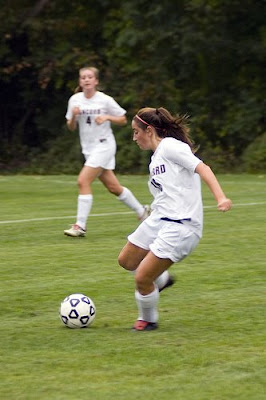
Chip pass

Saturday, May 24, 2008

Upright Volley


In general, this is either a shot or clearance. If it is a shot, the aim is to keep the ball down by getting head and knee over the ball, striking it late, and not following through. The ball should be hit about a foot, or 16inches off the ground (30-40cm).

For a clearance, the body leans back, the ball is hit earlier and the leg follows through. The ball can be hit relatively comfortably from 1-2 feet (30-60cm) off the ground.

Lofted instep pass

Lofted instep pass

Used primary for long kicks from defensive positions, crosses from deep, or corners, this pass has the advantage of bypassing opponents on the ground. Accuracy can be a problem on windy days. Players of the quality of Glenn Hoddle could play this pass and make the ball ‘sit up’ on the landing, like a top golfer putting backspin on an iron shot.

Lofted Instep pass: Approach and Execution


Approach:


Similar to an instep pass but with the non-kicking foot alongside but slightly behind the ball and the body leaning backwards. The head goes up just before impact. To make the ball rise more steeply, approach from a more angled approach. To get more power, approach more directly.


Execution:
As for the instep pass, except you strike the lower part of the ball, not in the middle. Follow through is important.

Instep pass : Executive


Execution:

The ball is struck in the centre with the laces area of the boot. The toe of the boot should be pointing towards the ground but at a slight angle, not vertical. Power comes from the calf muscles - hit ‘through’ the ball. The kicking foot should follow through slightly across the body.

Instep pass : Approach

Approach:

Where possible, on the move from a slight angle. As with most passes the non-kicking foot should be aligned alongside the ball pointing in the intended direction of the pass or shot. To keep the ball down the eyes should be focused on the ball at the moment of impact - this ensures the head stays down. Arms are flung out for balance, especially on the non kicking side, foot muscles are tightened just before the impact and the legs swings from the knee.

Friday, May 23, 2008

Instep pass

Once players have progressed beyond the “toe-punt stage, this is the most natural way of kicking the ball. In the 1980s, when English football leaned towards “long ball”, “direct play” methods, it was often the most common form of passing because it provides more power than any other method of striking the ball. David Beckham is probably the best practitioner of this skill in the English game today.